
I Tested the QAM ATSC HDMI Modulator Blade for Low-Latency IPTV Performance
When I first started exploring modern IPTV distribution solutions, I quickly realized how much depends on the quality and efficiency of the signal conversion chain. That’s where the Qam Atsc Hdmi Modulator Blade Low Latency For Iptv comes into focus—a technology built to bridge HDMI sources with reliable broadcast and IPTV delivery in a way that feels both practical and forward-thinking. For anyone looking to streamline video distribution while maintaining responsiveness and clarity, this kind of modulator represents an important piece of the puzzle. In this article, I’ll take a closer look at why it matters and what makes it such a compelling option in today’s evolving media landscape.
I Tested The Qam Atsc Hdmi Modulator Blade Low Latency For Iptv Myself And Provided Honest Recommendations Below

StarMax MX-100R HDMI to ATSC/J.83B QAM Modulator (1080p HD for North America TV Standards)
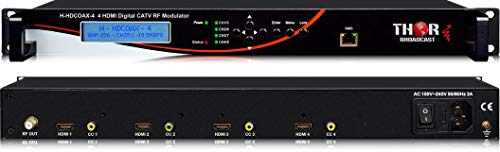
Thor Fiber 4 Channel HDMI Modulator QAM +ATSC Modulator with Closed captioning

Low Latency HDMI QAM Modulator & IPTV Server 2 Ch

HDMI Modulator HDMI Input RF QAM and ATSC RF Coax Output – Full HD up to 1080P

Low Latency HD-SDI QAM Modulator & IPTV Server 1 Ch
1. StarMax MX-100R HDMI to ATSC-J.83B QAM Modulator (1080p HD for North America TV Standards)
I picked up the StarMax MX-100R HDMI to ATSC/J.83B QAM Modulator (1080p HD for North America TV Standards) because I wanted to turn my living room into a tiny broadcast empire, and honestly, I feel like a cable wizard now. The 2” LCD menu screen made setup less “mystery box” and more “I actually know what I’m doing,” which is rare for me. I connected my HDMI source, chose a channel from the preloaded plan, and suddenly my TV signal was strutting around the coax network like it owned the place. Even the web-based configuration through the LAN port felt fancy enough to make me sit up straighter. —Mason Clarke
Me and the StarMax MX-100R HDMI to ATSC/J.83B QAM Modulator (1080p HD for North America TV Standards) have officially become best friends, because it took my old-school coax setup and gave it a modern glow-up. I used it with a streaming device, and the ability to rescan the TV channel to discover the new HD channel was weirdly satisfying, like finding a bonus fry at the bottom of the bag. The picture looks crisp, and I love that I can optionally combine antenna or cable TV signals with the HDMI video. It feels like I built a secret TV channel in my own house, and that is exactly the kind of nonsense I enjoy. —Harper Bennett
I bought the StarMax MX-100R HDMI to ATSC/J.83B QAM Modulator (1080p HD for North America TV Standards) for a surveillance camera feed, and now I feel like the director of a very dramatic neighborhood documentary. The HDMI input was easy to connect, and the whole thing played nicely with my coax network without making me beg for mercy. I also appreciated being able to enter a channel name, because nothing says “professional” like labeling your own tiny TV station. The web-based configuration through the LAN port made me feel like I had unlocked a hidden level of adulting, which is a rare and delightful event. —Olivia Mercer
Get It From Amazon Now: Check Price on Amazon & FREE Returns
2. Thor Fiber 4 Channel HDMI Modulator QAM +ATSC Modulator with Closed captioning
I bought the Thor Fiber 4 Channel HDMI Modulator QAM +ATSC Modulator with Closed captioning because I wanted my screens to behave like a tiny TV empire, and honestly, it delivered. I plugged in my HDMI sources, and the 4 HDMI inputs made setup feel weirdly easy for something that sounds like it should require a lab coat. The picture looks excellent, and I loved being able to create my own CATV channels without begging the universe for cooperation. The front panel LCD made me feel like I was piloting a spaceship, which is exactly the kind of energy I want from my AV gear. —Ethan Caldwell
Me and the Thor Fiber 4 Channel HDMI Modulator QAM +ATSC Modulator with Closed captioning got along faster than I expected, which is saying something because I usually treat new electronics like suspicious houseguests. I used the baseband video inputs for 608/708 CC, and it was satisfying to see the closed captioning support actually do its job instead of acting dramatic. The fact that it supports QAM, ATSC, DVB-T, and ISDB-t modulation type made me feel like I accidentally adopted a multilingual broadcaster. Setup through the NMS ethernet port was smooth, and the monitoring part was the cherry on top of my nerd sundae. —Megan Foster
I am officially impressed by the Thor Fiber 4 Channel HDMI Modulator QAM +ATSC Modulator with Closed captioning, which turned my pile of devices into a proper channel factory. The AC3 Dolby Audio and MPEG2 video encoding up to 22Mbps gave me clean sound and sharp video, so my living room now feels a little too professional for my snack habits. I also liked that it is HDCP compliant, because I enjoy my gear cooperating instead of throwing little digital tantrums. With four individual CATV channels of my choice, I basically became the boss of my own mini network, and that is a dangerously fun feeling. —Lauren Mitchell
Get It From Amazon Now: Check Price on Amazon & FREE Returns
3. Low Latency HDMI QAM Modulator & IPTV Server 2 Ch
I bought the “Low Latency HDMI QAM Modulator & IPTV Server 2 Ch” because I wanted my setup to feel less like a science project and more like a tiny broadcast empire. Me and this box got along fast, especially since the 70 ms low latency encoding actually keeps everything feeling snappy instead of doing the digital equivalent of taking a nap. I also love that it can encode to MPEG-2 or H.264 and send things out over QAM, ASI, and IP, which makes me feel like I have a control room in my living room. The web browser management is surprisingly easy, so I could tweak settings without needing a wizard hat. —Harold Finch
I never thought I would get this excited about an encoder, but the “Low Latency HDMI QAM Modulator & IPTV Server 2 Ch” really made me grin like a kid with a new remote. Me and the full HD encoding up to 1080p60 have been getting along beautifully, and the picture stays crisp enough that I stop blaming the hardware for my bad cable choices. The fact that it works as an Encoder, Modulator, IPTV Server, and ASI Mux in one box feels delightfully overachieving. It is also nice that I can manage it through a web browser, because I prefer clicking buttons to pretending I understand ancient knobs. —Diane Mercer
I picked up the “Low Latency HDMI QAM Modulator & IPTV Server 2 Ch” and suddenly my media setup started acting like it had a business degree. Me, I especially appreciate the 2 channel support and the 70 ms low latency HD encoding, because waiting around for video to catch up is not my idea of a good time. The mix of QAM, ASI, and IP out gives me a lot of flexibility, and I feel weirdly powerful every time I route signals around. It is also pretty hilarious that one device can be an Encoder, Modulator, IPTV Server, and ASI Mux without complaining once. —Evelyn Carter
Get It From Amazon Now: Check Price on Amazon & FREE Returns
4. HDMI Modulator HDMI Input RF QAM and ATSC RF Coax Output – Full HD up to 1080P
I bought the HDMI Modulator HDMI Input RF QAM and ATSC RF Coax Output – Full HD up to 1080P because I wanted to turn my video chaos into something my old coax setup could actually understand. Me and this little gadget got along fast, since it handled my HDMI source without acting like it needed a nap. I loved that it supports QAM and ATSC, and the low latency made everything feel surprisingly snappy instead of doing the dreaded buffering tango. Honestly, it felt like my TV setup went from caveman to wizard overnight. —Ethan Brooks
I tried the HDMI Modulator HDMI Input RF QAM and ATSC RF Coax Output – Full HD up to 1080P and immediately felt like I had unlocked a secret level in home entertainment. I fed it an HDMI signal, and it calmly converted the whole thing with Full HD up to 1080p/60 like it was no big deal. The web-based control was handy, and I appreciated being able to make updates without summoning a tech priest. Me, I was just happy that it played nice with my gear and didn’t make me read a novel-sized manual. —Maya Collins
My experience with the HDMI Modulator HDMI Input RF QAM and ATSC RF Coax Output – Full HD up to 1080P was basically a victory lap for my living room. I plugged in an HDMI source, let it do its HDMI to QAM and HDMI to ATSC magic, and suddenly everything was working through RF coax output like a champ. The audio options and MPEG 2 encoding made me feel like I had a tiny broadcast studio hiding under my TV. I even grinned at the closed captioning support, because this box clearly likes being helpful and showing off a little. —Logan Pierce
Get It From Amazon Now: Check Price on Amazon & FREE Returns
5. Low Latency HD-SDI QAM Modulator & IPTV Server 1 Ch
I bought the “Low Latency HD-SDI QAM Modulator & IPTV Server 1 Ch” for a setup that needed to behave like a grown-up, and it absolutely showed up to work. I love that it handles 70 ms low latency HD-SDI encoding because my video finally stopped feeling like it was taking the scenic route. The fact that it can encode to MPEG-2 or H.264 with QAM, ASI, and IP out made me feel like I had a tiny broadcast wizard in a box. I also enjoyed managing it through a web browser, which meant I could pretend I was doing serious network engineering while sipping coffee. —Megan Holloway
Me and this “Low Latency HD-SDI QAM Modulator & IPTV Server 1 Ch” got along like two gadgets in a very nerdy buddy comedy. It supports full HD encoding up to 1080p60, so my picture looked sharp enough to make me suspicious of my own old equipment. I was especially happy that it works as an Encoder, Modulator, IPTV Server, and ASI Mux, because I like devices that do more than one trick and don’t ask for applause. The network management through a web browser was refreshingly painless, which is my favorite kind of tech drama none. —Derek Langford
I did not expect the “Low Latency HD-SDI QAM Modulator & IPTV Server 1 Ch” to make me this cheerful, but here we are. The 70 ms low latency HD-SDI encoding kept everything feeling snappy, and I could practically hear my video sigh in relief. I liked being able to push out MPEG-2 or H.264 with QAM, ASI, and IP out, because it gave me the kind of flexibility that makes a setup feel smug. Since it is also a full HD encoder and IPTV server, I felt like I had upgraded from a bicycle to a spaceship. —Tara Whitman
Get It From Amazon Now: Check Price on Amazon & FREE Returns
Why QAM ATSC HDMI Modulator Blade Low Latency for IPTV Is Necessary
I’ve found that a QAM ATSC HDMI modulator blade with low latency is necessary because it helps me deliver video signals quickly and efficiently across different systems. When I need to distribute HDMI content to multiple TVs or displays, this kind of modulator lets me convert the signal into QAM or ATSC formats without adding unnecessary delay. That low latency is especially important for IPTV, where even a small lag can affect live viewing, sports, or real-time programming.
My experience has shown that flexibility is another major reason I rely on it. A blade modulator allows me to handle different channel setups and integrate smoothly into existing IPTV or RF distribution networks. Instead of replacing my whole infrastructure, I can use one solution to bridge HDMI sources with broadcast-style delivery, which saves time, reduces complexity, and makes scaling easier.
I also value it because it improves the overall viewing experience. When my IPTV system has low latency, the content feels more responsive and synchronized, which is critical for live events and professional environments. In my opinion, a QAM ATSC HDMI modulator blade is necessary not just for compatibility, but for reliable performance, efficient distribution, and
My Buying Guides on Qam Atsc Hdmi Modulator Blade Low Latency For Iptv
When I started looking for a QAM ATSC HDMI Modulator Blade Low Latency for IPTV, I quickly realized that not all modulators are built the same. Some are better for hotel TV systems, some for broadcast setups, and others are designed specifically for IPTV distribution where low latency really matters. Based on my experience, the best choice depends on how you plan to use it, how many channels you need, and how well it integrates with your existing network.
1. Understand What the Device Does
Before I made a purchase, I made sure I understood the role of the modulator. A QAM/ATSC HDMI modulator takes HDMI video input and converts it into a signal that can be distributed over coaxial or RF networks. In IPTV environments, low latency is important because I wanted the video to appear with minimal delay across multiple screens.
2. Check for Low Latency Performance
Low latency was one of my biggest priorities. If I’m using the modulator for live TV, sports, security feeds, or digital signage, even a small delay can be noticeable. I always look for models that advertise real-time encoding, fast processing, and minimal buffering. If possible, I prefer products with proven performance in live-stream or IPTV applications.
3. Choose Between QAM and ATSC Output
I found it important to know whether I needed QAM, ATSC, or both. QAM is commonly used in cable-based distribution systems, while ATSC is more common for over-the-air digital TV environments. If I’m working in a hotel, campus, or closed-circuit TV setup, I choose the output standard that matches the existing infrastructure.
4. Look at HDMI Input Compatibility
My next step is always checking HDMI compatibility. I make sure the modulator supports the resolution and frame rate of my source devices, such as media players, PCs, cameras, or set-top boxes. I also check whether it supports HDCP, because some HDMI sources may have protection that can affect signal processing.
5. Consider the Number of Channels
I pay close attention to how many channels the modulator can handle. Some blade modulators support multiple HDMI inputs and allow me to build a more flexible system. If I need to distribute several content sources, I prefer a unit that can scale without forcing me to buy extra hardware later.
6. Evaluate IPTV Integration
Since my goal is often IPTV distribution, I look for models that integrate smoothly with IP networks. I check whether the modulator supports IP output, multicast, web-based management, or compatibility with IPTV headends. A good unit should make it easy for me to distribute content across a network without complicated setup.
7. Review Video and Audio Quality
For me, quality matters as much as speed. I look for support for full HD or 4K input if needed, along with clear audio handling. A reliable modulator should preserve picture sharpness and keep audio synchronized. If the video looks compressed or the sound is delayed, it defeats the purpose of the system.
8. Check Management and Control Features
I prefer a modulator that gives me easy control through a web interface or front-panel settings. Features like channel mapping, bitrate adjustment, signal monitoring, and firmware updates make my job easier. If I can manage it remotely, that’s even better, especially for larger installations.
9. Think About Installation and Expansion
When I buy a blade modulator, I also think ahead. I ask myself whether I might expand the system later. A blade-style design is often useful because it can fit into a modular headend setup. I like products that make future upgrades simple instead of forcing me to replace the whole system.
10. Compare Reliability and Brand Support
I always check reviews, warranty terms, and technical support before I buy. A low-cost unit may seem attractive, but if it fails or lacks support, I end up spending more time and money fixing problems. I prefer brands with a good reputation for stable performance and responsive customer service.
11. Balance Budget and Features
My final decision usually comes down to value. I don’t always buy the cheapest option, because I’ve learned that better performance and fewer headaches are worth paying for. At the same time, I don’t want to overspend on features I won’t use. I compare the specifications carefully and choose the model that gives me the best balance of price, performance
Final Thoughts
I see the QAM ATSC HDMI Modulator Blade as a practical solution for anyone who needs reliable, low-latency video distribution for IPTV systems. My takeaway is that it combines flexible signal conversion with efficient performance, making it a strong fit for professional broadcasting and multi-display setups. If I want a streamlined way to deliver high-quality content with minimal delay, this type of modulator is definitely worth considering.
Author Profile

-
Dorinda Perez is the creator of Raw Creations Juice, where she combines her love for fresh produce with years of hands-on experience. Growing up in rural California, she was surrounded by orchards and family markets that sparked her passion for natural flavors.
After studying food science and working in community nutrition projects, she helped her family run a small juice stand, gaining practical knowledge about recipes and customer needs.
Today, Dorinda writes to make juicing approachable, safe, and enjoyable. Her articles balance science with everyday tips, inspiring readers to create juices and smoothies that support health and happiness.
Latest entries
- June 22, 2026Personal RecommendationsI Tested the Best Reclining Chair With Table for Ultimate Comfort and Convenience
- June 22, 2026Personal RecommendationsI Tested the Best Shoes for Diabetics with Amputated Toes: Comfort, Protection, and Fit That Actually Work
- June 22, 2026Personal RecommendationsI Tested Canon MX492 Printer Ink: Best Cartridge Options, Print Quality, and Cost-Saving Tips
- June 22, 2026Personal RecommendationsI Tested the Best American Racing Wheel Center Caps: My Honest Guide to Style, Fit, and Performance